

2026 RIIFF Filmmaker Spotlight Series: Death Do Us Part, directed by Abigail Ory and David Chávez-Grant, co-written by Masha Strasburger
Article Written By Marina Muradian
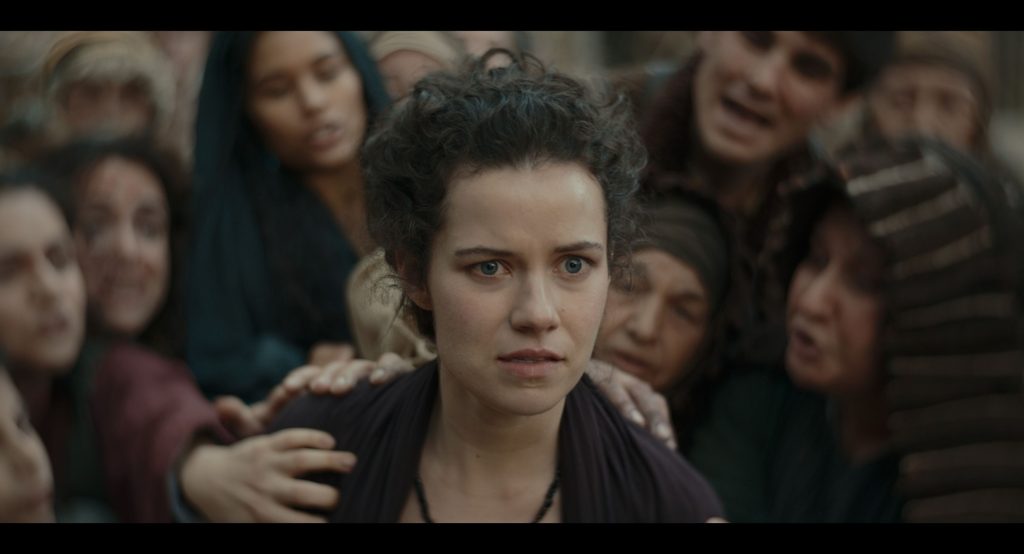
Set against the backdrop of the Black Plague in 14th-century Italy, Death Do Us Part introduces Giulia, our headstrong protagonist whose unexpected relationship with Death himself sets off a chain of events filled with a striking romance and delicious dark comedy. The film raises a multitude of questions exploring morality and what it means to challenge a close minded community. Giulia navigates a world plagued with misogyny, and must fight to claim her place as the doctor her community desperately needs. I had the pleasure to discuss the film with directors Abigail Ory and David Chávez-Grant, alongside co-writer Masha Strasburger and discover the inspirations behind the film. The conversation also touches on the collaborative work of the film’s creative team including production designer Crispian Sallis, costume designer Carlo Poggioli, and cinematographer Ferran Paredes Rubio, whose contributions helped bring the film’s fantastical medieval world to life. The team also describes how the experience during the COVID-19 pandemic shaped a story about finding connection in the face of the most uncertain of times.
What drew you to telling this particular story? And why did it feel important to tell now?
Abigail: What got me interested was my bandmate showing me a song containing the danse macabre motif, which included references to another common motif, “death and the maiden,” where death and a young woman dance together. I was very inspired by these lyrics and I called Masha up and said “I want to tell a story about death and the maiden, I want to tell a story exploring what kind of person that maiden would be to fall in love with Death, and what circumstances might put someone in that position”. In terms of why it felt important to tell this story now, our modern American society has a way of talking about death that is haphazard at best. We were reflecting on what are time periods where the cultural approaches this topic is very different, and the middle ages came to us. As a writer conceiving of this with Masha pre-COVID-19, and directing this with David post COVID-19, I feel like it took on a different relevance after we have all been through this pandemic. A story about the plague that people will relate to differently. We initially chose the plague as something that felt foreign and then surprisingly it became very not foreign extremely rapidly.
David: It’s a very unique story, a unique perspective with what one’s relationship with death could be like literally, and it’s a modern if not timeless story as Giulia’s story is one of being coerced, forced, or asked to check certain boxes that are administrative in certain ways. If you’ve ever been asked to do a thing and you ask why and people go “well that’s just the way we do things around here,” I think Giulia’s story is rather relatable. And I also think from a form perspective, the idea of doing a not quite pure comedy not quite pure drama that integrates music in a less traditionally broadway musical way was interesting as well. I think all those things combined made it very compelling and something worth working on.
Masha: When Abigail reached out to me to ask me to write Death Do Us Part with them it was an instant appeal. We took a screenwriting course together in high school and I was so excited to get to work on a really folkloric project. Long before I ever set pen to page I was first and foremost an oral storyteller. I learned campfire stories and shaggy dog jokes. I have always been preoccupied with the folklore and fairytale form, so I think the opportunity to tell a really original fairytale was intensely appealing. And as for why now– we live in a moment of really intense misogynistic backlash. I think that in the same way Shakespeare frequently sets his plays in Italy, we hope that by setting this story of a woman’s futile attempt to escape the patriarchy around her alone, we make it easier for our audience to engage with it.

What sparked the idea of the film?
Abigail: Masha and I originally wrote Death Do Us Part as a stage play and we had been getting told by the girlfriend of somebody involved in the production that this really seemed like a movie, that it was using a lot of filmic devices. But we essentially never considered making it a movie because we just assumed we would never make a movie. That was kind of why it was off the table initially.
Masha: Making a movie just felt impossible I guess. But then Abigail met a couple of people who took an interest in them as a director. We at the time were in the middle of expanding Death Do Us Part from a one act into a full-length stage play. These new connections asked Abigail, “so what are you working on right now?” And she said, “I’ve got this great screenplay about a young woman falling in love with the grim reaper.” They loved it and were like, “when can we read it?” And we were like, “soon!” And so we were like, alright, we have to turn this into a movie now. I was so excited because I love film structure. My first love with dramatic writing was really the screenplay so getting to come back to film was so exciting.
What inspired Giulia as a character?
Abigail: It was that same opening question that Masha and I started with, which was “what kind of maiden would it take to fall in love with Death?” was the essential question we were exploring as we were creating Giulia as a character. Figuring out what does she see in him, for us to some degree he is an escape from her circumstance. What is the kind of person that would be willing to overlook Death’s profession and see the guy? All of that was inspiring to us as we were creating this character. The last thing I would say about Giulia is that Giulia reminds me of when I was a little kid taking math class. I’m not bad at math but when I was a kid I was really bothered by it because I’m somebody always asking why, and it turns out the answer to “why?” in math either gets really complicated really fast or you have to get told not to ask those questions yet. I feel like that energy, the need to question “well, why is this the way we do things?” is very much what we were channeling with Giulia and something a lot of people find relatable.
Masha: We landed on Giulia who is quite relatable. There were moments where we doubted ourselves, there was this element of, will we find someone likeable who is so full of dissatisfaction and resentment? The answer is yes! We’re all carrying that with us so much. A lot of young people feel really trapped in this moment and so that dissatisfaction Giulia feels is of the moment.
What was the collaboration between you and the cinematographer?
David: Ferran is very patient as a man and as a DOP. He had a certain way of always backing us in our desires. From the jump he was pretty keen to build a unique look for the film that wasn’t overly on the nose type of fantasy or overly stylized, but also not so raw or grounded that it didn’t have any mystical element to it. We talked a lot about classical painting references, Goya in particular and Caravaggio, a lot of Italian and Spanish golden age painters. The way that they arrange subjects in a frame particularly for things like ensemble shots was something we had talked about quite a bit.
Abigail: With Ferran being extremely patient and a huge supporter of ours, it felt like we had a relationship of a100 percent trust with him quickly. He was extremely supportive of our ideas even when he wasn’t immediately feeling them. He also was not afraid to come up with a concept that was kind of a swing– most of those made it into the movie. Giulia’s dress color change shot was all his idea! I feel like he also was not afraid to be honest with us, to be like hey I don’t think this is such a great idea or you really should rethink this. It always felt like a dialogue collaborating with him in a way that made us more creative and more creative faster. He brought a lot to this movie that went beyond our concept initially of how a comedy could be shot. I remember David and I talking about, “can you shoot comedy handheld?” And it turns out the answer is absolutely yes! Quite successfully, but that had not been something on our radar visually especially for our funnier scenes– we were like that just won’t make it funny. But it turns out it can be very funny. Ferran’s style which feels very “real life” really made this fantasy fairy tale world one we were living in rather than one we were just observing.
How did you develop the film’s visual language and atmosphere?
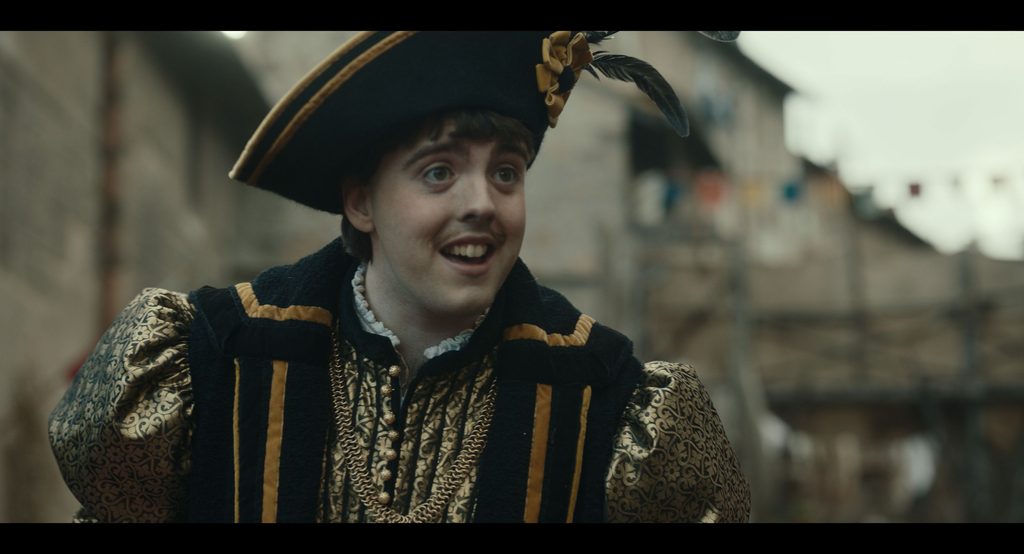
Abigail: One of our biggest priorities throughout this process, from Masha and I writing to David and I directing, was to really make it feel like a lived-in world and not make it feel staged. To make it feel like a little village we could imagine actually having existed in 1347. A lot of what that requires is other creative collaborators who know how to make something feel extremely tactile and I feel like that is something both Carlo and Crispian are absolute masters of. Crispian put an enormous amount of effort into thinking, “how would Giulia be living in her space? Where would her things be? Why would her things be in those particular locations?” Carlo as well created costumes that felt really lived in and didn’t fall either into the category of looking too ostentatious and fairytale for a small rural village, or falling into the other trap medieval movies can fall into where everyone wears burlap and looks sad about it. Our costumes ended up feeling like something you could imagine people wearing, but that also felt lively and engaging and fun and like something you’d like to wear. Carlo also really nailed the real life-to-fantasy balance we wanted to be striking, and history-to-fantasy balance we wanted to be striking. Our male characters’ costumes have codpieces and detachable sleeves, but also, we have human sphynx outfits in our royal court.
David: One great thing Crispian did for us was really creating a space that we could immerse ourselves in when we were on set. Not just things that you see on screen, but a lot of things you will never see on screen but for instance the actors were able to see while they were on set. He provided things they could play with, things they could use or ask questions about as a way to motivate their performance. I think that’s why shooting on practical locations that are dressed so well is such an advantage over doing something on a stage. We could basically shoot 360 in any space we walked into because the whole thing was immaculately dressed. We had a plethora of angles to choose from in every instance which is a real gift as a director. We were lucky we could walk around and shoot any which way and always trust that something interesting was going to be in the frame. And then Carlo really understood the balance we were trying to strike in terms of realism with a bit of heightened style as well. He always kept things grounded in this medieval world but nothing was ever, ever boring to look at. He did a great job getting inside each of the characters and giving them something that made sense for them to wear based on who they are in the script. From Giulia’s very practical toolbelt to Bianca’s more “a woman about town” flowy dress, Carlo always made good decisions about motivating costume choices in the characters.

What has been the most rewarding part about sharing this film with audiences so far?
Masha: It’s really exciting to see our peers engage with it. Production meeting after production meeting we were the youngest people in the room so it’s really exciting to get this film out to the people who we wrote it for– for Gen Z, for the tumblr girlies! And as a writer, it’s really nice to hear people laugh.
Abigail: I think one of the most rewarding things about sharing this movie has been the variety of people that have told me they really resonate with Giulia’s story. A lot of young women entering various male dominated professions definitely have a really obvious connection to our heroine who is going through the exact same thing. I’ve been heartened to hear a lot of people from a lot of different backgrounds say that they had been through something that Giulia has been through, or that they have seen themselves through her– even if not directly, seeing the way that the fairytale form can relate to so many people has been really wonderful.
David: For me it’s a lot of the small things that people will notice. Especially as a director you put in so much time, effort, and thought and you ask a lot of people to do the same into what arguably are rather small decisions that end up on the screen. For instance we spent a lot of time recurring this image of chess. We staged a series of games over the course of the movie to hopefully appropriately show or represent what is going on in the film. We had a chess consultant tell us what kind of game or move the characters might be in at a particular time. Somebody came up to me while we were in Providence and asked me about that and I was happy that somebody even noticed because there were a ton of things like that in the film that you put so much time, effort, and care into. It’s just nice to have that effort recognized.
